Zona Fit — Gym Operations Platform & React 19 UI/UX Refactoring
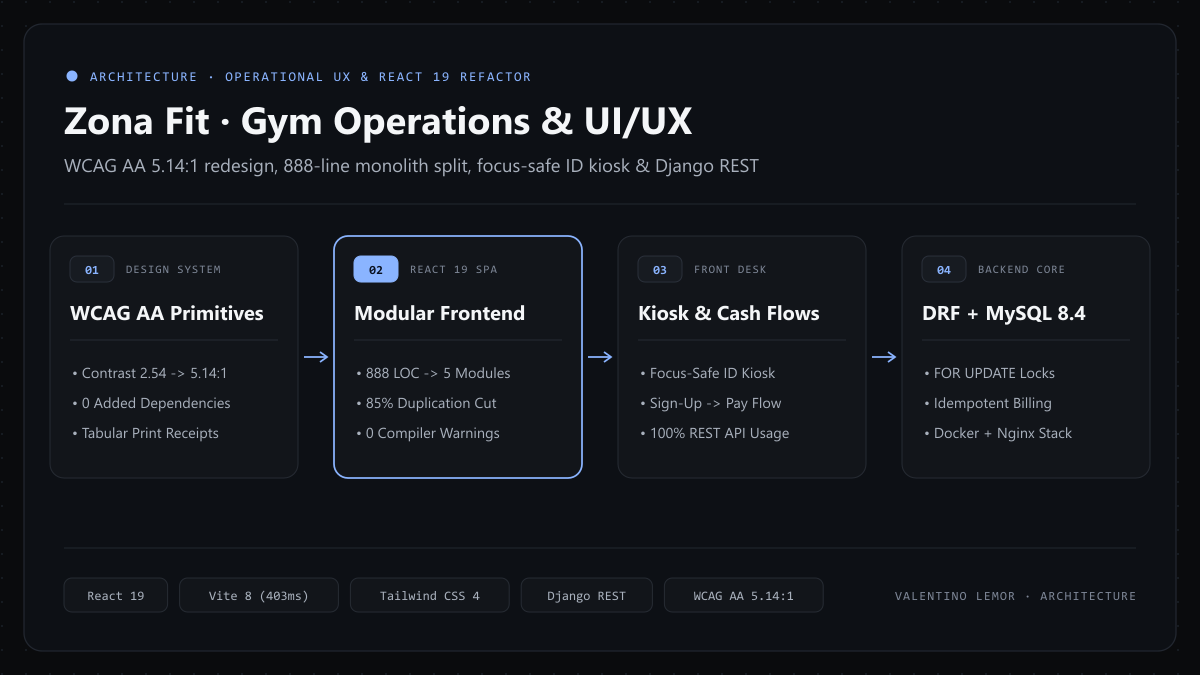
Full-stack gym operations platform in Django REST, MySQL 8.4, and React 19: WCAG AA redesign (5.14:1), 888-line payment monolith split, focus-preserving ID kiosk, and 0 React Compiler / oxlint warnings.
Problem
Zona Fit runs daily gym operations across four role-based profiles (Admin, Reception, Trainers, and Members), spanning two contrasting environments inside a single frontend: high-pressure front-desk cash register workflows and an entrance Kiosk for rapid ID check-ins alongside the mobile member portal.
While the Django REST Framework and MySQL 8.4 backend already enforced strict transactional guarantees (SELECT ... FOR UPDATE locks, idempotent payments, refund audit logs, and soft deletes), an initial frontend audit surfaced four major bottlenecks:
- Visual inconsistency & WCAG AA failures: five conflicting primary button styles across views, failing primary-button contrast (
#10b981on white = 2.54:1 vs. the 4.5:1 AA floor), a noisy 6-color dashboard where real expiration alerts blended into static metrics,`<html lang="en">`on a Spanish app, disabled mobile pinch-zoom (user-scalable=no), and 5 modals missingrole="dialog",Escapehandling, andhtmlForbindings. - Front-desk & Kiosk friction: expired staff sessions on the kiosk went unnoticed until a member check-in failed with
401; disabling the input during API lookups dropped browser focus after every check-in; creating a new member closed the modal without offering immediate first-membership payment. - Underused REST API endpoints: the UI ignored three ready backend resources (
/api/attendance/today/,/api/accounts/users/options/, and/api/payments/transactions/). - React technical debt:
PagosPage.jsxheld 888 lines in a single monolith;ClientesPage.jsxandEmpleadosPage.jsxduplicated ~85% of their logic (720lines); paginated search lackedAbortController, and 9 warnings remained active underoxlint/ React 19 Compiler.
Architecture and decisions
Guided by a strict “Operational Clarity” design principle—color communicates actionable state, never decoration—the entire frontend was redesigned and refactored without touching backend contracts and with zero new external dependencies (package.json unchanged).
Unified accessible Design System & zero-dependency primitives
- WCAG AA restrained palette: neutral canvas (
#F8FAFC), crisp 1px borders (#E2E8F0), dark navigation shell (#0F172A), and a single accessible institutional accent in deep emerald (#047857, 5.14:1 contrast ratio with white). - Tabular precision & custom UI primitives: properly loaded Plus Jakarta Sans and JetBrains Mono with
tabular-numsacross clocks, cash totals, and receipt codes. Built customButton, accessibleModal(role="dialog",aria-modal,Escape, scroll lock), asyncConfirmModal,Badge,PageHeader,TableSkeleton, and a lightweightaria-live="polite"ToastProvider.
High-velocity front-desk flows powered by 100% of the REST API
- Actionable KPI Dashboard: replaced 6 multicolored cards with 4 quiet dark-ink KPIs; only Expiring in 7 days shifts to amber when action is required, deep-linking straight to pre-filtered subscriptions. Added a zero-dependency 7-day attendance bar chart backed by
GET /api/attendance/today/. - Modular Cash Register & printable receipts: broke the 888-line monolith into 5 focused modules (
PaymentModal,ReceiptModal,RefundModal,TransactionsTab, and page container), adding live member autocomplete (/api/accounts/users/options/), auditable transaction/refund history (/api/payments/transactions/), and a dedicated@media printreceipt layout for printing or PDF export. - Continuous Sign-Up → Payment & hands-free Kiosk: merged Members and Staff into a shared
UserDirectoryfeaturing a direct Create & collect payment action. Upgraded the Kiosk with a proactive reception-session status bar, numeric keypad (inputMode="numeric"), and permanent focus retention viareadOnly(instead ofdisabled) plusrequestAnimationFrame.
// React 19 Compiler-compliant derived loading state paired with AbortController
const requestKey = `${page}:${debouncedQuery}:${statusFilter}`;
const loading = loadedKey !== requestKey;
Challenges
- React 19 Compiler compliance & async race conditions: replacing synchronous
setLoading(true)calls insideuseEffectwith derived request-key loading (loading = loadedKey !== requestKey) andAbortControllereliminated race conditions, prevented jarring table layout shifts while filtering, and split context modules (auth-context.js,toast-context.js) for clean Fast Refresh. - Real-world front-desk ergonomics: keeping continuous barcode/keyboard input focus intact across rapid consecutive ID check-ins and shaving 4 repetitive clicks from member onboarding-to-payment without changing the Docker + Nginx + MySQL 8.4 backend.
Outcomes
- Verified WCAG AA accessibility: raised primary-button contrast from 2.54:1 to 5.14:1, fixed document language/mobile zoom, and upgraded all 5 modals with full keyboard and ARIA semantics.
- Zero-warning production build: dropped
oxlint/ React 19 Compiler diagnostics from 9 warnings to 0 warnings / 0 errors across 39 files; productionvite buildcompletes in 403 ms (8.63 kBCSS gzip,130.02 kBJS gzip) with 0 added dependencies. - Modular codebase & 100% API utilization: split the
888-line payments monolith into5specialized modules, eliminated ~85% duplication (720lines) via a unified directory, and surfaced weekly attendance trends, auditable cash history, live autocomplete, and printable PDF receipts.
A full walkthrough covering the Dashboard, Cash Register/Receipts, Onboarding-to-Payment, and ID Kiosk is available via the Video demo link in the header and sidebar. Proprietary codebase reserved for commercial SaaS/licensing.